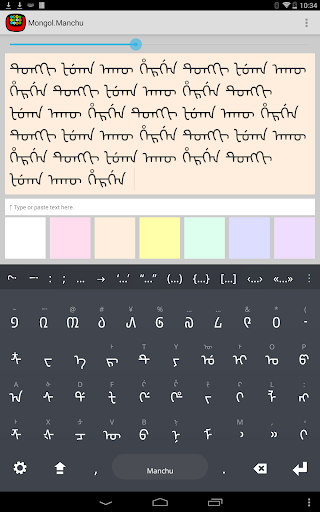
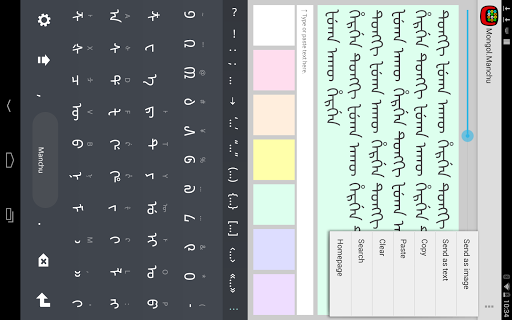
Mongolian/Manchurian font plugin for Multiling O Keyboard. This is not an independent app, please install OKeyboard along with this plugin.
Instruction:
⑴ Install this plugin and
Multiling O Keyboard
.
⑵ Run O Keyboard and follow its setup guide.
⑶ Slide space bar to switch languages.
Please email if you have any questions.
Wikipedia:
The traditional or classical Mongolian alphabet, sometimes called Hudum 'traditional' in Oirat in contrast to the Clear script (Todo 'exact'), is the original form of the Mongolian script used to write the Mongolian language. It fails to distinguish several vowels (o/u, ö/ü, final a/e) and consonants (t/d, k/g, sometimes ž/y) that were not required for Uyghur, which was the source of the Mongol (or Uyghur-Mongol) script.[1] The result is somewhat comparable to the situation of English, which must represent ten or more vowels with only five letters and uses the digraph th for two distinct sounds. Ambiguity is sometimes prevented by context, as the requirements of vowel harmony and syllable sequence usually indicate the correct sound. Moreover, as there are few words with an exactly identical spelling, actual ambiguities are rare for a reader who knows the orthography.
Letters have different forms depending on their position in a word: initial, medial, or final. In some cases, additional graphic variants are selected for visual harmony with the subsequent character.
Sister systems
Manchu alphabet
Oirat alphabet (Clear script)
Vagindra alphabet
Galik alphabet
Evenki alphabet
Xibe alphabet
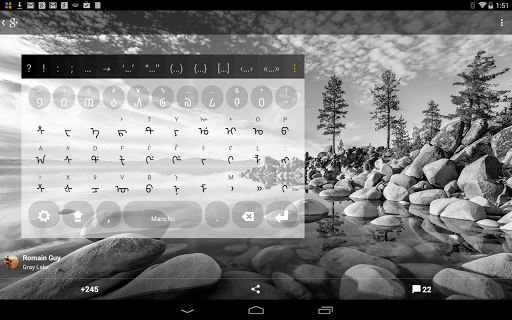
Photo: Gray Lake by Romain Guy



9Apps 4.9