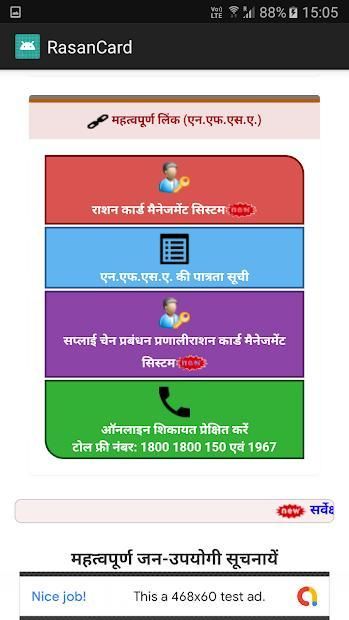
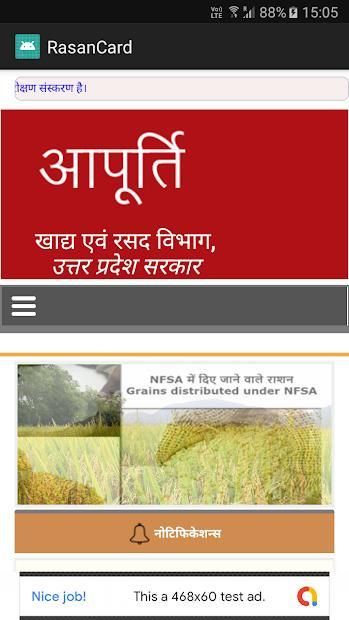
There you can get the android apps APK installed on your device. 20,000+ users downloaded Rasan Card 2019 latest version on 9Apps for free every week! The App has powerful functions. This hot app was released on 2018-10-04. I believe that if you are an android apps lover, you would not miss it.
Ration cards are an official document issued by state governments in India to households that are eligible to purchase subsidized food grain from the Public Distribution System (under the National Food Security Act). They also serve as a common form of identification for many Indians.
Under the National Food Security Act, all state governments in India have to identify households that are eligible for purchasing subsidized food grain from the Public Distribution System and provide them with ration cards. There are two types of ration cards under NFSA[2]:
Priority ration card - priority ration cards are issued to households that meet the eligibility criteria set by their state government. Each priority household is entitled to 5 kilograms of food grain per member.
Antyodaya (AAY) ration cards are issued to "poorest of poor" households. Each AAY household is entitled to 35 kilograms of food grain.
Before the NFSA was enacted, there were three types of ration cards[3]:
Above Poverty Line (APL) ration cards that were issued to households living above the poverty line (as estimated by the Planning Commission). These households received 15 kilogram of food grain (based on availability).
Below Poverty Line (BPL) ration cards that were issued to households living below the poverty line. These households received 25-35 kilograms of food grain.
Antyodaya (AAY) ration cards that were issued to "poorest of poor" households. These households received 35 kilograms of food grain.
Kartu jatah adalah dokumen resmi yang diterbitkan oleh pemerintah negara bagian di India untuk rumah tangga yang memenuhi syarat untuk membeli gandum makanan bersubsidi dari Sistem Distribusi Publik (di bawah Undang-Undang Ketahanan Pangan Nasional). Mereka juga berfungsi sebagai bentuk identifikasi umum bagi banyak orang India.
Di bawah Undang-Undang Keamanan Pangan Nasional, semua pemerintah negara bagian di India harus mengidentifikasi rumah tangga yang memenuhi syarat untuk membeli butir makanan bersubsidi dari Sistem Distribusi Publik dan memberikan mereka kartu ransum. Ada dua jenis kartu ransum di bawah NFSA [2]:
Kartu ransum prioritas - kartu ransum prioritas dikeluarkan untuk rumah tangga yang memenuhi kriteria kelayakan yang ditetapkan oleh pemerintah negara bagian mereka. Setiap rumah tangga prioritas berhak mendapatkan 5 kilogram makanan gandum per anggota.
Kartu ransum Antyodaya (AAY) diterbitkan untuk rumah tangga "termiskin dari miskin". Setiap rumah tangga AAY berhak mendapatkan 35 kilogram biji-bijian.
Sebelum NFSA diberlakukan, ada tiga jenis kartu ransum [3]:
Di atas garis kemiskinan (APL) kartu ransum yang dikeluarkan untuk rumah tangga yang hidup di atas garis kemiskinan (seperti yang diperkirakan oleh Komisi Perencanaan). Rumah tangga ini menerima 15 kilogram biji-bijian (berdasarkan ketersediaan).
Di bawah garis kemiskinan (BPL) kartu ransum yang dikeluarkan untuk rumah tangga yang hidup di bawah garis kemiskinan. Rumah tangga ini menerima 25-35 kilogram biji-bijian.
Kartu ransum Antyodaya (AAY) yang diterbitkan untuk rumah tangga "termiskin dari yang miskin". Rumah tangga ini menerima 35 kilogram biji-bijian.
Ration cards are an official document issued by state governments in India to households that are eligible to purchase subsidized food grain from the Public Distribution System (under the National Food Security Act).

9Apps 4.9