
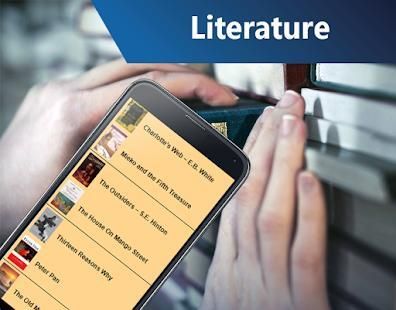
Following is the introduction of a wonderful App. 30,000+ users downloaded Literature latest version on 9Apps for free every week! You'll found many people are using it. This hot app was released on 2018-04-17. Be sure that you check your current app before you start a run.
Literature, a body of written works. The name has traditionally been applied to those imaginative works of poetry and prose distinguished by the intentions of their authors and the perceived aesthetic excellence of their execution. Literature may be classified according to a variety of systems, including language, national origin, historical period, genre, and subject matter.
For historical treatment of various literatures within geographical regions, see such articles as African literature, African theatre, Oceanic literature, Western literature, Central Asian arts, South Asian arts, and Southeast Asian arts. Some literatures are treated separately by language, by nation, or by special subject (e.g., Arabic literature, Celtic literature, Latin literature, French literature, Japanese literature, and biblical literature.
Definitions of the word literature tend to be circular. A collegiate Dictionary considers Literature to be writings having excellence of form or expression and expressing ideas of permanent or universal interest. The 19th century critic Walter Pater referred to the matter of imaginative or artistic literature as a transcript, not of mere fact, but of fact in its infinitely varied forms. But such definitions assume that the reader already knows what literature is. And indeed its central meaning, at least, is clear enough. Deriving from the Latin littera, a letter of the alphabet, literature is first and foremost humankind’s entire body of writing, after that it is the body of writing belonging to a given language or people, then it is individual pieces of writing.
But already it is necessary to qualify these statements. To use the word writing when describing literature is itself misleading, for one may speak of oral literature or the literature of preliterate peoples. The art of literature is not reducible to the words on the page; they are there solely because of the craft of writing. As an art, literature might be described as the organization of words to give pleasure. Yet through words literature elevates and transforms experience beyond mere pleasure. Literature also functions more broadly in society as a means of both criticizing and affirming cultural values.
Literature is a form of human expression. But not everything expressed in words even when organized and written down is counted as literature. Those writings that are primarily informative technical, scholarly, journalistic would be excluded from the rank of literature by most, though not all, critics. Certain forms of writing, however, are universally regarded as belonging to literature as an art. Individual attempts within these forms are said to succeed if they possess something called artistic merit and to fail if they do not. The nature of artistic merit is less easy to define than to recognize. The writer need not even pursue it to attain it. On the contrary, a scientific exposition might be of great literary value and a pedestrian poem of none at all.
If the early Egyptians or Sumerians had critical theories about the writing of literature, these have not survived. From the time of Classical Greece until the present day, however, Western criticism has been dominated by two opposing theories of the literary art, which might conveniently be called the expressive and constructive theories of composition.
Download Literature application NOW! it's FREE!


![[ASMR] Reading The Little Prince in Chinese | Soft Spoken | Page Turning Paper Sounds | 小王子 中文助眠 screenshot 3](https://i.ytimg.com/vi/pH3mfDCxIak/mqdefault.jpg)



9Apps 4.9